
Resources
Cleaning robots in commercial buildings: a readiness checklist
Autonomous floor scrubbers follow programmed routes, see obstacles with cameras and lidar, and send alerts when they need a refill or get stuck. Whether one works in your building depends less on the machine than on the building: Wi-Fi along the routes, doors and elevators, a charging spot, clear accessible paths, a privacy decision about cameras, and a person ready to answer its alerts.
Request a quoteCall (408) 668-0624
What autonomous cleaners do in a building
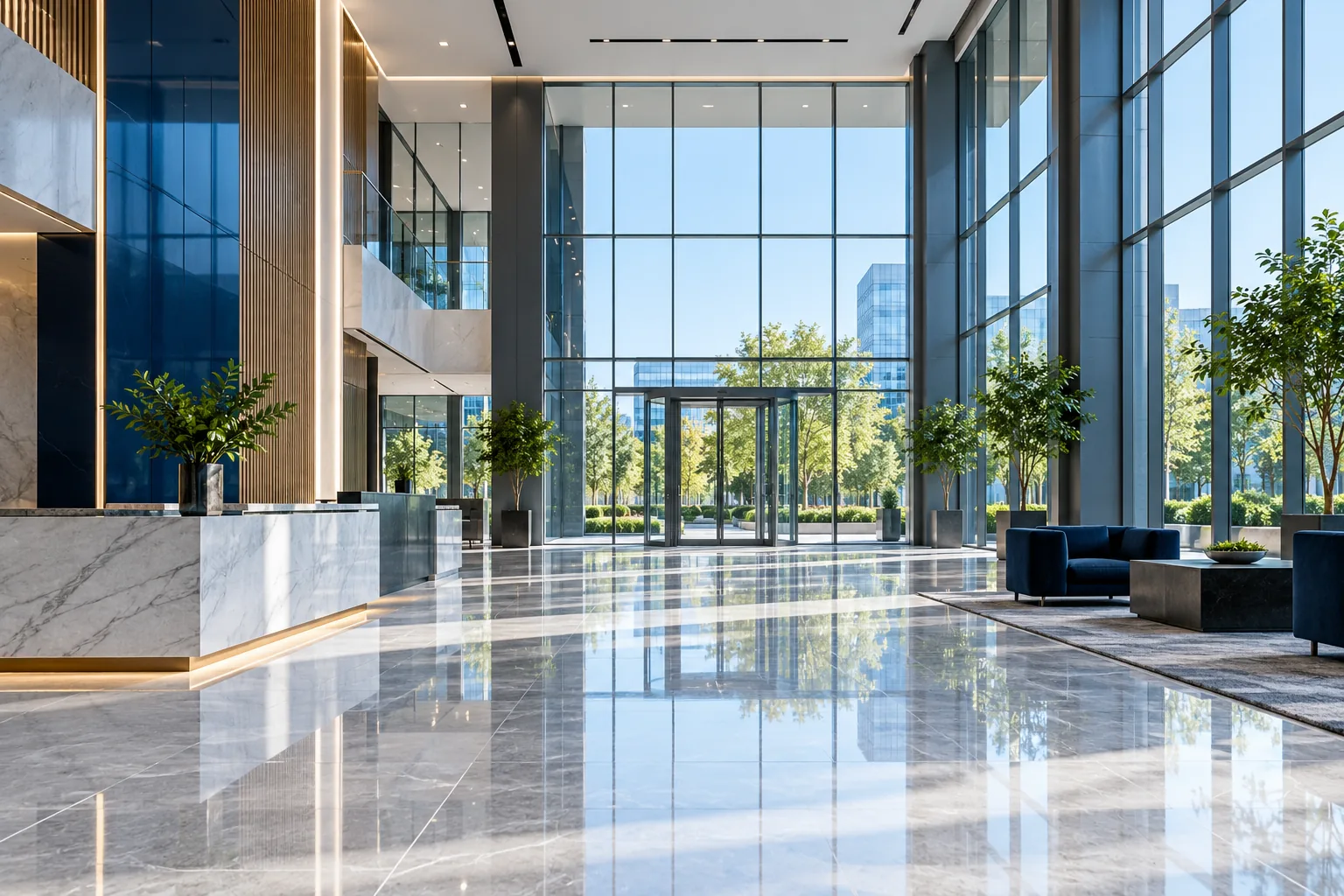
Most cleaning robots in commercial buildings are floor machines: scrubbers, sweepers and vacuums that run a route on their own. University pilots give a plain picture of how they work. In a 2019 campus pilot, an autonomous scrubber followed preprogrammed routes, used several cameras and lidar to see and steer around obstacles, let staff set water and chemical levels on a screen, sent a text when it needed a refill or hit a problem, returned to its starting point and produced data reports. It was placed in a building with wide hallways.
In a 2022 university facilities pilot, the scrubber could run in manual or autonomous mode, and a technician taught it each route by driving it once so the machine could repeat it. Setting up the routes for one building took four hours. Those two details, the teaching and the open floor, run through every readiness question below.
Safety standards: which one covers what
Several standards touch mobile robots, and they cover different machines. None of them is a single cleaning-robot certification, so ask the maker which standards a machine was designed and evaluated to, and let your safety team decide which ones you work to.
| Standard | What it covers | Worth knowing |
|---|---|---|
| IEC 63327:2021 | Battery-powered automatic floor treatment machines for commercial indoor use: sweeping, scrubbing, wet or dry pick-up, polishing, waxing or sealing, shampooing | Used with IEC 60335-2-72; expects machines to avoid hazardous contact with people and names malls and schools as places they run; excludes slopes over 20% and corrosive or explosive settings |
| CSA C22.2 No. 336 | Rechargeable battery-operated commercial robotic floor treatment machines with traction drives | The North American standard UL 3300 points floor machines to |
| UL 3300 (revision August 14, 2026) | Service, communication, information, education and entertainment robots used by or near the public, indoors and out | Does not cover commercial floor cleaning machines; portable automatic vacuums go to UL 1017 |
| ISO 13482:2014 | Personal care robots that travel on the ground | Confirmed in 2020; a revision retitled for service robots, covering commercial uses, was at the approval stage as of November 2026 |
| ANSI/A3 R15.08 series | Industrial mobile robots: Part 1 (R15.08-1-2020, reaffirmed 2026) for makers, Part 2 (R15.08-2-2023) for integrators and fleets, Part 3 (R15.08-3-2026) for users | Written for industrial-type workplaces such as warehouses, labs and plants; Part 3 excludes non-industrial mobile robots |
Part 3 of R15.08 gives a useful model for any owner, even outside an industrial setting: apply the maker’s and integrator’s information, train people, set safe work procedures, run a risk assessment, keep risk reduction in place, document it, and repeat the cycle whenever the robot, the task or the space changes.
OSHA and workplace hazards
OSHA says it has no standards written specifically for robots; its general industry standards apply instead, including walking-working surfaces, noise, PPE, lockout/tagout, machine guarding and electrical rules, and State Plan states such as California can set stricter rules. OSHA’s robotics pages focus on industrial robots and note that many robot accidents happen during non-routine work such as programming, maintenance, testing and setup.
NIOSH groups workplace robots as industrial, professional service and collaborative robots, mobile machines included. Its list of hazards covers struck-by and caught-between injuries, crushing, slips, trips and falls, and electrical hazards, plus newer concerns such as unexpected contact, distraction and worker stress, distrust and worry about job loss among them. ISSA’s advice to involve staff early, covered below, speaks to that last point.
Readiness checklist before a pilot
This checklist is our suggestion, drawn from the university pilots, the two building studies below, ISSA’s workloading guidance and the ADA and privacy rules on this page. Work through it with your facility, IT, safety and privacy leads before a machine arrives.
| Item | What to check | Who decides |
|---|---|---|
| Routes and floor area | Large open floors a machine can run without constant stops; which tasks it would take on each shift | Facility manager with the cleaning provider |
| Maps | Time to map each floor; every floor needs its own map in multi-story studies | Facility manager and the robot’s supplier |
| Wi-Fi | Coverage along each route and in elevator lobbies; what happens when the signal drops | IT team |
| Doors and elevators | Doors with automatic closers, elevator door timing and any integration with building systems | Owner and elevator contractor |
| Charging spot | A place for the charger, kept out of accessible routes and clear floor spaces | Owner |
| Accessible routes | Where the machine may stop or dock so it never blocks required clear width for long | Owner |
| Cameras and data | What images are stored, where, for how long, and what notice occupants get | Owner’s privacy counsel and IT team |
| People | Who teaches routes, refills the machine and answers stoppages and alerts on each shift | Facility manager with the cleaning provider |
| Real-condition trial | Runs with obstacles, layout changes and seasonal temperature and humidity | Facility manager |
| Quality standard | Updated inspection points showing what the machine covers and what stays with people | Facility manager with the cleaning provider |
| Risk assessment | Hazards, procedures and training documented, and reviewed when anything changes | Owner’s safety team |
Our guide to building a facility services scope and the facility cleaning scope builder help you list the tasks first, which shows quickly how much of the work is open floor at all.
What the studies found about elevators and doors
Two recent studies looked at robots moving between floors. Neither robot was a cleaning machine, but both met the same building limits a scrubber would.
- Transport robot, 2025 university study. Each floor needed its own prerecorded map, and semi-automated mapping of a three-story building took a few hours. All control stayed on board because Wi-Fi could drop inside elevators and when the robot switched access points. Elevator doors stayed open about 6 seconds, and the robot could not pass doors with automatic closers. It completed 88.6% of 79 tasks in an elderly care facility and 80.0% of 40 tasks in a university office building, with most failures at doors and elevators.
- Delivery robot, 2026 single-hospital study. The robot was linked to elevators through a module on the elevator control panel. Weak wireless coverage caused delays of 5 to 7 seconds, so doors sometimes closed before the handshake finished (2 of 14 failures), and failures rose above 90% with six or more people in the car. The study covered 122 missions over 12 days.
For a cleaning pilot, the plain lesson is to start on one floor with open routes, then add elevator and door work only after the owner and its elevator contractor have tested it.
Accessible routes and clear floor space
A robot that stops in a corridor can turn into an obstacle. Under the 2010 ADA Standards, an accessible route is at least 36 inches clear, narrowing to 32 inches for no more than 24 inches of length; routes under 60 inches wide need passing spaces at least every 200 feet; objects mounted between 27 and 80 inches high may stick out no more than 4 inches into a circulation path; and a wheelchair clear floor space is at least 30 by 48 inches. Businesses open to the public must keep accessible features working, with isolated or temporary interruptions for maintenance allowed. Our suggestion: dock and charge machines away from accessible routes and plan routes so a working or stalled robot never blocks the required width for long. The owner decides where robots may stop.
Privacy: cameras and sensors in California
Robots that see with cameras can collect images of people. The California Consumer Privacy Act applies to for-profit businesses doing business in California that meet at least one threshold: annual gross revenue above an inflation-adjusted amount, buying, selling or sharing personal information of 100,000 or more California residents or households, or earning at least half of annual revenue from selling or sharing it. Its categories of personal information include biometric information and audio, electronic, visual, thermal and similar information. Covered businesses give notice at collection, and residents have rights to know, delete, correct, opt out of sale or sharing and limit use of sensitive data. The temporary exemption for employee information ended December 31, 2022, and the law is enforced by the Attorney General and the California Privacy Protection Agency.
Whether a given robot’s images fall under the CCPA turns on the business itself, so the owner’s privacy counsel decides. Settle what is stored, where, for how long and what notice occupants get before the first run.
Where people still do the work
ISSA’s 2022 article on fitting robots into workloading says machines usually take on large open areas, while detail cleaning stays with people, and it recommends involving staff early and teaching them to start robot tasks and respond to stoppages and alerts. In practice that leaves restrooms, touchpoints, desks, trash and recycling, edges and corners, spills, stairs and anything a machine cannot reach with the cleaning team. Adoption was still limited in ISSA and AACEM’s February 2019 survey: of 250 responses, 27% used autonomous cleaning equipment, 7% had used it before and 66% never had.
Robots also leave a data trail. If you track work in a maintenance system, our CMMS software comparison shows how the platforms handle work orders and reporting, and our guide to cleaning quality inspections covers how to check results whoever does the work.
Get help
If you are weighing a pilot, Continental can go through your current cleaning scope with you, mark which tasks suit an open-floor machine and which stay with people, and write the cleaning plan, from floor care to restrooms, to your building’s rules on where a robot runs. Tell us about your building and we’ll arrange a time to walk it with you.
A few useful answers
Common questions
Is there an OSHA standard for cleaning robots?
No. OSHA says it has no robot-specific standards and applies its general industry rules, such as walking-working surfaces, machine guarding and electrical safety, instead.
Which standard covers an autonomous floor scrubber?
IEC 63327:2021 covers battery-powered automatic floor treatment machines for commercial indoor use, and UL 3300 points North American floor machines to CSA C22.2 No. 336.
Can a cleaning robot ride the elevator?
Only after the owner and its elevator contractor set it up and test it. In a 2026 hospital study, weak wireless coverage let elevator doors close before the robot finished connecting, and failures rose sharply in crowded cars.
Do cleaning robots with cameras raise privacy questions in California?
They can. The CCPA’s categories include visual and biometric information, so the owner’s privacy counsel should decide what images are kept and what notice occupants get.
What cleaning work stays with people when a robot runs the floors?
Restrooms, touchpoints, desks, trash, edges and corners, spills and stairs, plus refilling the machine and answering its alerts.